
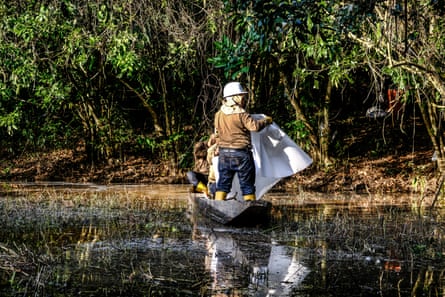
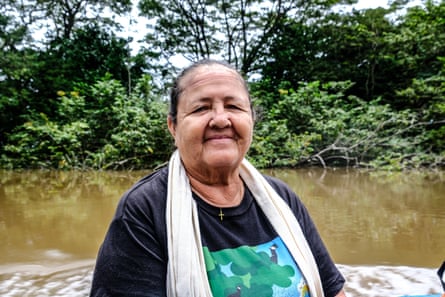
Standing on top of her small vessel, a machete gripped tightly, Yuly Velásquez hacks away at reeds coated in darkened muck. Not far away, a ruptured pipeline has spilled a layer of crude into the San Silvestre marshlands in Barrancabermeja, the heart of Colombia's oil industry, suffocating the aquatic life.
“The devastation is immense,” explains Velásquez, head of a sustainable fishing organisation. “For the fish, the animals and vegetation, it means a death sentence.”
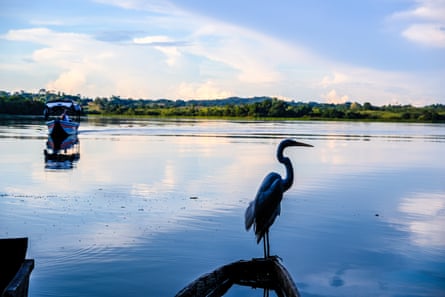
With its marshes, lakes and woodlands, Barrancabermeja sits in a biodiversity hotspot – the home of at-risk aquatic reptiles and mammals, and the wetlands act as a route used by roaming big cats.
Yet it is also a major crude production site. Industrial flares shoot into the sky from a complex network of tanks, pipes and chimneys, producing up to 250,000 barrels of crude oil a day.
For decades, the local industrial complex, operated by the national oil company, has also been alleged to releasing oil and toxic waste into nearby rivers and wetlands, and of causing leaks that contaminate the region’s fishing grounds.
Officials and locals say the impact has been devastating: fish populations have crashed, water quality has declined and numbers of manatees – once regarded as a guardian spirit of the wetlands – are now thought to be on the verge of disappearing.
A report published last year identified more than 800 records of “significant ecological incidents” linked to the oil company, with most occurring from the mid-1990s to the mid-2010s.
The report, based on a collection of internal documents, also described a “network of deception” allegedly used to hide the accidents, noting that a fifth were not reported to authorities.
Another report last year also found the company has had leaks hundreds of times since then.
The company has denied allegations that it has polluted local water sources, insisting it fully complies with environmental statutes. But by the end of last year, huge swaths of the territory were still contaminated by a pipeline fracture, with an slick coating the water and the air reeking of petrol.
The company says its local branch is working to control and clean up the leaks, maintains that its operations follow environmental regulations and highlights spending to cut discharges and protect wildlife.
The firm also rejected the allegations contained in the leaked documents, insisting that incidents were officially recorded and most historical contamination sites had already been cleaned up.
A Livelihood Poisoned
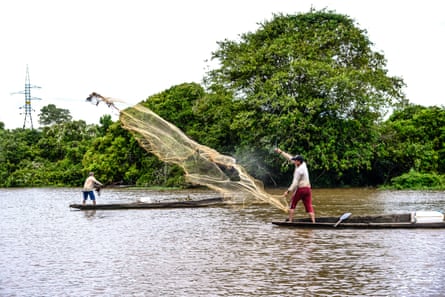
Yet for riverside communities, which depend almost entirely on fishing for their income, the impact is obvious. “Yet again, hundreds of fish, snakes, birds, turtles and caimans have died overnight,” says Luis Carlos Lambraño, 56, who has been fishing in these waters for 37 years.
“If we can’t fish, we can’t eat,” he says. “I feel complete despair.”
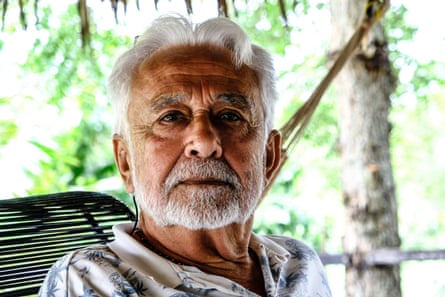
Ronaldo Martínez, 68, who farms water buffalo, says the contamination has become increasingly evident.
“The buffalo drink the water, get poisoned and die,” he says. “We’ve had about 30 buffalo die on us this way in the last five years.”
Martínez says that coming across a dead animal was not common in the past. “It happened sometimes, but it wasn’t very common,” he says. “But lately, it’s become normal to find dead animals, dead caimans, dead fish.” He adds that when the fish are cut open during oil spills, “they taste like oil”.
He says the responsibility lies with the oil company. “[It] is our largest company,” he says. “They should have a way of managing their waste ponds. Their processing systems should be working.”
The Rule of the "Gasoline Gangs"
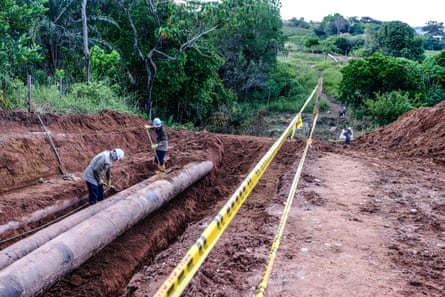
Compounding the crisis is the expansion of criminal gangs that seek to rule the waterways. So-called “oil smuggling rings” have moved into the area, which is considered a important passageway for moving illegal goods, breaching the oil pipelines that crisscross through the waterways to pilfer and traffic the fuel illicitly.
“Every single day they steal the gasoline,” says Velásquez, who, along with her colleagues, monitors biodiversity in the area. “They collect it in these huge containers – when they break, which has happened at least twice, it spills into all of the water.”
The presence of armed groups has also made fishing extremely risky. Local activists say they have faced numerous intimidations, coercion and murder plots. Drones are used by armed groups to track and follow fishing boats until they leave the area.
Velásquez is one of the campaigners at risk. She says she has suffered several incidents on her home, three assassination attempts – one in which her bodyguard was shot – and many threats to her family for protesting the contamination and the armed groups.
The threats are taken very seriously as Colombia is one of the most dangerous countries worldwide for land and environmental defenders, accounting for a third of all documented lethal attacks.
“It has been devastating,” Velásquez says. After another fishing leader was assassinated in 2012, she says it “took a long time for people to raise their voices again”.
Lambraño describes an incident in February when he was stopped by gang members and forced from the river. “They fired shots in the air, then followed me, shining their torch on me, until I left,” he says.
Eñi Salazar, who has fished these waters since she was seven, also has numerous experiences of being threatened for merely fishing. Armed men have twice intercepted her in the wetlands.
In one case, they took her motor and threatened to kill her. In another, they opened fire during the fishing community's environmental monitoring activities, with bullets hitting an engine.
“They said to me: ‘We know who you are, we know your face, so if we ever see you here again, we’ll kill you’,” the 66-year-old says.
A major human rights organization has reported a constant climate of fear for fishing families in Barrancabermeja, recording blackmail, direct threats and people repeatedly forced to leave the area.
“Fishing families have felt the pressure from the armed groups for a long time, but in the last few years their presence has expanded,” says a researcher focused on the region.
“Oil smugglers, armed groups – everyone wants the water,” he says. “Whoever controls the water controls Barrancabermeja.”
Such intimidation caused the flight of 26 fishing families in early 2025. “You don’t mess with the armed groups. If you don’t listen, they will kill you,” says Velásquez. She estimates that about 100 of her colleagues have stopped fishing.
A Simple Request
But for Velásquez, waiting for action is no longer an option. “Every day we see places where wildlife used to live disappear,” she says. “We can’t wait for someone else to come and take care of it for us.”
What the community wants is simple, Velásquez says. “We want to be left alone to live in peace,” she says, “and to truly be able to enjoy our marsh, our river, day and night, without limits or restrictions telling us what time we can enter or what time we can leave, or where we can and can’t be.”


